







Guideline for the Evaluation and Diagnosis of Chest Pain
SCMR is happy to share the release of the Guidelines for the Evaluation and Diagnosis of Chest Pain! Thank you to the following organizations who contributed to the creation of these guidelines: American Heart Association, American College of Cardiology, American Society of Echocardiography, American Society of Nuclear Cardiology, American College of Chest Physicians, Society for Academic Emergency Medicine, Society of Cardiovascular Computed Tomography, and Society for Cardiovascular Magnetic Resonance. The new guidelines are very much patient-symptom focused, and take into account cardiovascular risk and the impact of age, sex and ethnicity. They also extensively consider the strengths and limitations of each of the four diagnostic imaging modalities to encourage an ‘appropriate choice’ of diagnostic test in a range of clinical scenarios. In terms of imaging recommendations for chest pain, the recommendations are broadly broken down into two scenarios, acute chest pain and stable chest pain. Within these two presentation scenarios, there are then specific recommendations based on whether the patient has known or no-known coronary artery disease (CAD). Generally speaking, while CCTA features prominently in the algorithms, CMR has a Class 1 or Class 2a recommendation in all clinical scenarios, and is now always at least equivalent to other functional imaging tests (stress echo, MPS-SPECT, PET). The table below summarizes some of the pertinent CMR recommendations.
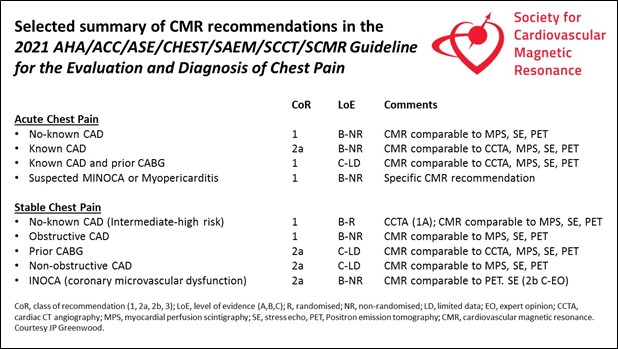
Endorsed by SCMR, the guidelines recognize that CMR has a critical role in the timely, accurate, and cost-effect evaluation of patients with chest pain. These recommendations reflect decades of highest-quality clinical trial data accrued by meticulous investigators from many centers around the world.
Stress Perfusions Webinar Series
Part 1: Stress Perfusion CMR in the 2021 ACC/AHA Chest Pain Guidelines
Speakers: John Greenwood and Raymond Kwong, MD
Moderators: Subha Raman, MD; Sven Plein, MD; Purva Parwani, MD
Part 1: Stress Perfusion CMR in the 2021 ACC/AHA Chest Pain Guidelines – ESPAÑOL
Speakers: John Greenwood and Raymond Kwong, MD
Moderators: Subha Raman, MD; Sven Plein, MD; Purva Parwani, MD
Part 2: Stress Perfusion CMR in Patients with Chest Pain: Evidence-Based Summary
Speakers: Andrew Arai, MD, and Michael Salerno, MD
Moderators: Victor Ferrari, MD; Matthais Friedrich, MD; Balaji Tamarappoo, MD
Part 2: Stress Perfusion CMR in Patients with Chest Pain: Evidence-Based Summary – ESPAÑOL
Speakers: Andrew Arai, MD, and Michael Salerno, MD
Moderators: Victor Ferrari, MD; Matthais Friedrich, MD; Balaji Tamarappoo, MD
Part 3: How to Start a Stress CMR Service?
Speakers: Chiara Buchiarelli-Duuci, MD; Christopher Dyke, MD
Moderators: Scott Yang, MD; Mark Westwood, MD; Manish Matwani, MD
Part 4: Stress CMR Perfusion Cases: Guideline Scenarios Read with the Experts
Speakers: Christopher Kramer, MD; Purvi Parwani, MD; Cheton Shenay, MD; Bobby Heydari, MD
Moderators: Eike Nagel; Faisal Nabi, MD; Christopher Kramer, MD